
The Enterprise AI Adoption Framework
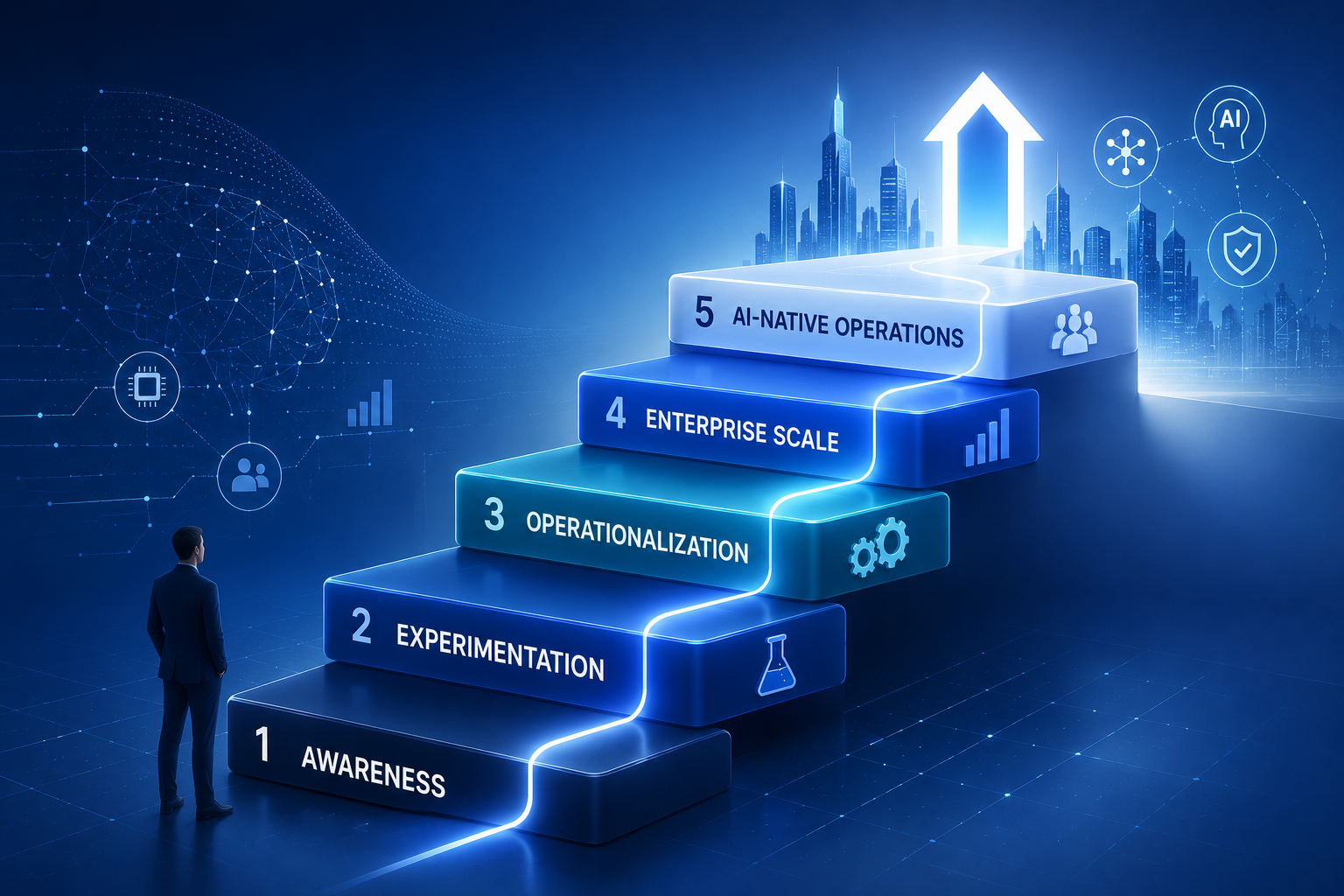
A Practical Roadmap for Moving from AI Curiosity to AI-Native Operations
Over the past few years, organizations across every industry have experimented with Artificial Intelligence.
Some launched chatbots.
Others deployed generative AI tools.
A few automated repetitive workflows.
Yet despite the excitement surrounding AI, many enterprises continue to struggle with a critical question:
How do we move from isolated AI experiments to organization-wide transformation?
The challenge is not technology.
The challenge is adoption.
Successful AI transformation requires a structured approach that aligns people, processes, technology, governance, and business objectives.
This framework outlines the five stages organizations typically progress through on their journey toward becoming AI-native enterprises.
Why Most AI Initiatives Fail to Scale
Many organizations follow a familiar pattern:
- Executive team becomes interested in AI
- Teams experiment with AI tools
- A few successful pilots emerge
- Adoption slows
- Business impact remains limited
The problem is not a lack of technology.
The problem is a lack of organizational readiness.
Without a structured adoption framework, AI often remains trapped within isolated departments rather than becoming a strategic business capability.
The Enterprise AI Adoption Framework
Organizations typically evolve through five stages.
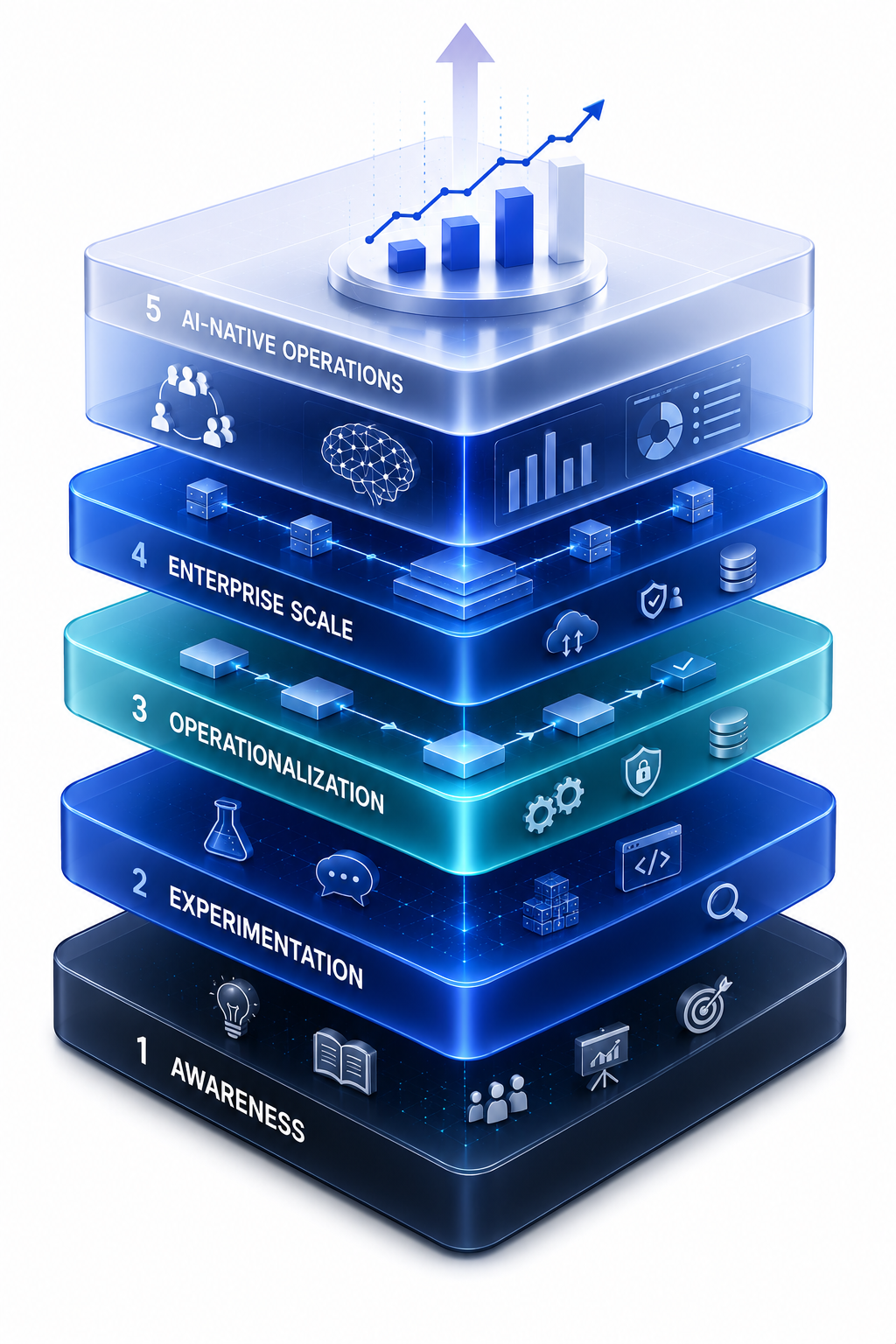
Each stage represents a shift in organizational maturity.
The objective is not simply adopting AI tools.
The objective is transforming how the organization operates.
Stage 1: Awareness
Every transformation begins with awareness.
At this stage, organizations are exploring what AI means for their business.
Common activities include:
- Executive briefings
- AI education programs
- Industry research
- Market analysis
- Competitor assessments
- Internal workshops
The primary goal is understanding opportunities and risks.
Characteristics of Stage 1
Leadership Driven - Initiatives often originate from senior leadership.
Limited Technical Adoption - Few production AI systems exist.
High Curiosity - Teams are eager to learn.
Low Organizational Readiness - Governance, data foundations, and operating models are still immature.
Stage 2: Experimentation
Once awareness increases, organizations begin testing practical applications.
This stage focuses on learning through controlled experimentation.
Common initiatives include:
Generative AI Pilots - Content generation, research assistance, and productivity enhancement.
Internal Assistants - Knowledge search and employee support tools.
Process Automation - Targeted workflow improvements.
Customer Experience Enhancements - Chatbots and support automation.
Analytics Use Cases - Predictive insights and reporting.
Objectives of Stage 2
The goal is not immediate ROI.
The goal is learning.
Organizations should identify:
- High-value use cases
- Technical feasibility
- Data requirements
- Adoption challenges
- Governance considerations
Common Mistake
Many organizations attempt to scale too quickly before establishing repeatable success patterns.
Successful enterprises treat experimentation as a structured discovery phase.
Stage 3: Operationalization
This is where AI begins creating measurable business value.
Successful pilots are transformed into production-grade capabilities.
Organizations start focusing on:
Reliability - Can AI operate consistently?
Security - Can solutions meet enterprise standards?
Governance - Can risks be managed effectively?
Integration - Can AI connect with existing business systems?
Adoption - Will employees use these solutions regularly?
Characteristics of Stage 3
Organizations begin establishing:
- AI Centers of Excellence
- Governance policies
- Data management standards
- AI development processes
- Monitoring frameworks
AI moves beyond innovation teams and starts entering day-to-day operations.
Stage 4: Enterprise Scale
At this stage, organizations stop treating AI as individual projects.
Instead, they build enterprise-wide capabilities.
Focus areas include:
Shared AI Platforms - Reusable infrastructure across departments.
Common Governance Models - Consistent security, compliance, and risk management.
Enterprise Data Strategy - Unified knowledge and intelligence foundations.
Agentic Workflows - AI systems coordinating across functions.
Cross-Functional Adoption - AI embedded within multiple business units.
Organizational Changes
Leadership begins viewing AI as a strategic capability rather than a technology initiative.
Funding models evolve.
Operating structures mature.
Transformation becomes enterprise-wide.
Stage 5: AI-Native Operations
This represents the highest level of maturity.
AI is no longer viewed as a separate capability.
It becomes part of how the organization operates.
Characteristics include:
Intelligence Everywhere - AI supports every major business function.
Agent-Human Collaboration - Employees work alongside intelligent systems.
Continuous Learning - Systems improve through feedback loops.
Data-Driven Decisions - Insights flow directly into business operations.
Adaptive Workflows - Processes evolve dynamically based on real-time information.
What Changes at This Stage?
Organizations stop asking:
"Where should we use AI?"
Instead they ask:
"How should we operate when intelligence is available everywhere?"
This mindset shift separates AI-native enterprises from organizations that merely deploy AI tools.
Key Enablers Across Every Stage
Regardless of maturity level, successful adoption depends on five foundational capabilities.
Leadership Alignment
Transformation starts at the top.
Executive sponsorship is critical.
Without leadership support, AI adoption often stalls after initial pilots.
Data Readiness
AI quality is directly tied to data quality.
Organizations must invest in:
- Governance
- Integration
- Accessibility
- Knowledge management
Workforce Enablement
Employees need:
- Education
- Training
- Clear communication
- New ways of working
Adoption is a people challenge as much as a technology challenge.
Governance & Risk Management
Responsible AI requires:
- Security controls
- Compliance frameworks
- Human oversight
- Monitoring mechanisms
Governance should accelerate innovation, not hinder it.
Change Management
Organizations must actively manage:
- Resistance
- Expectations
- Cultural shifts
- Process redesign
The most successful AI programs invest heavily in organizational change.
Measuring Progress
Organizations should evaluate maturity across five dimensions.
| Dimension | Key Question |
|---|---|
| Strategy | Do we have a clear AI vision? |
| Technology | Can our infrastructure support AI at scale? |
| Data | Is our data accessible and reliable? |
| People | Are employees prepared for AI adoption? |
| Governance | Can we manage risk responsibly? |
Progress across all five dimensions is required for sustainable transformation.
Common Adoption Traps
Tool-Led Transformation - Buying AI software without a clear strategy.
Pilot Fatigue - Running endless experiments without scaling.
Departmental Silos - Creating disconnected AI initiatives.
Ignoring Change Management - Assuming employees will naturally adopt new workflows.
Lack of Executive Ownership - Treating AI solely as an IT responsibility.
Final Thoughts
Enterprise AI adoption is not a technology project.
It is an organizational transformation journey.
The organizations creating the greatest value from AI are not necessarily those with the most advanced models.
They are the ones that systematically align strategy, people, data, technology, governance, and operations.
The Enterprise AI Adoption Framework provides a practical roadmap for navigating this journey.
By progressing from Awareness to AI-Native Operations, organizations can move beyond experimentation and build intelligence into the core of how they operate.
Key Takeaway
AI adoption is not measured by the number of AI tools deployed. It is measured by how deeply intelligence becomes embedded into the way the organization works, decides, and creates value.