
The Enterprise Agentic Architecture Framework
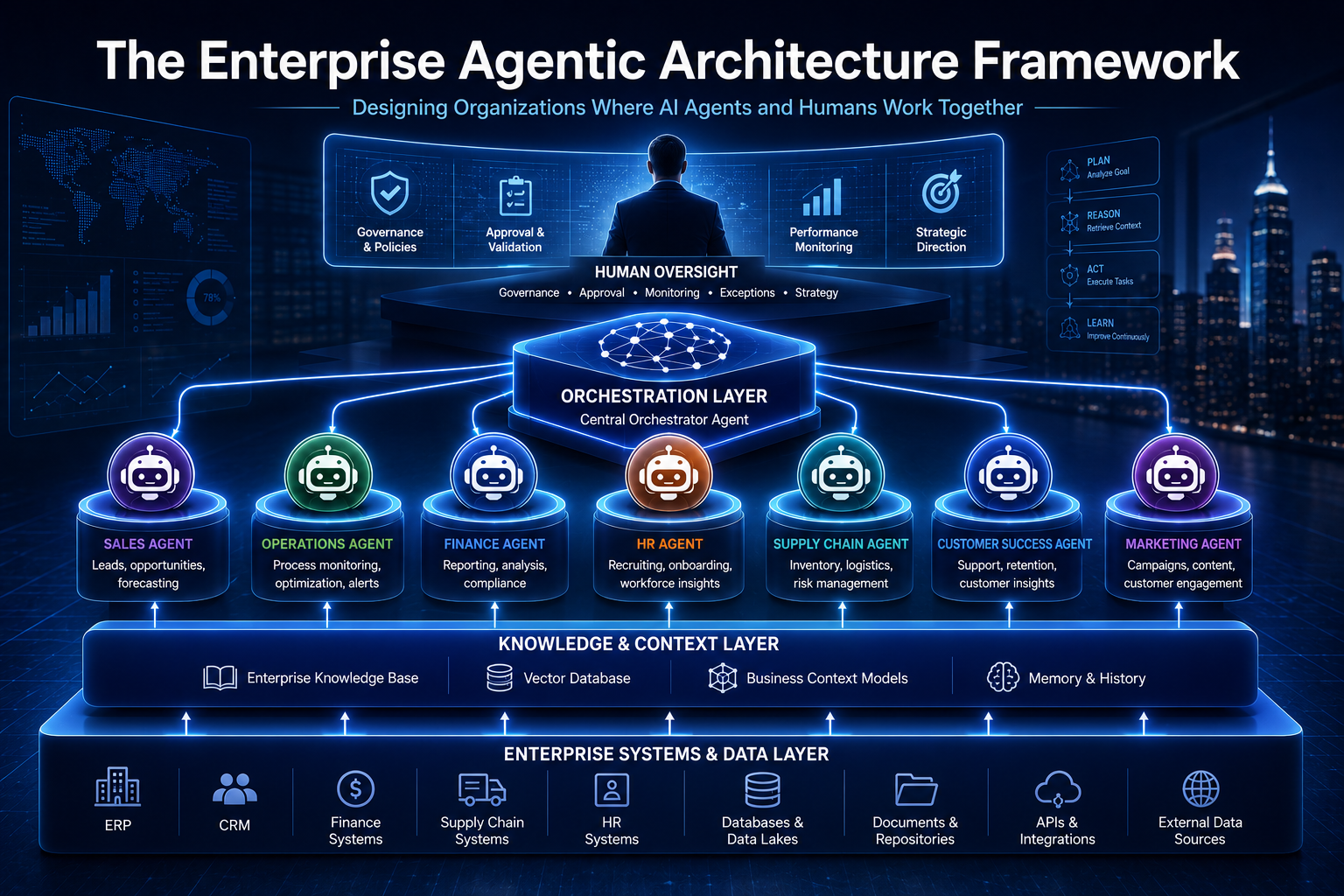
Designing Organizations Where AI Agents and Humans Work Together
Enterprise AI is entering a new phase.
For years, organizations have focused on automation, analytics, and machine learning models that generate predictions and insights.
Today, a new paradigm is emerging.
Instead of merely generating information, AI systems are beginning to reason, plan, coordinate, and execute work.
These systems are commonly referred to as AI Agents.
As organizations deploy multiple agents across departments, a new challenge emerges:
How should enterprises architect agent ecosystems that are secure, scalable, governed, and aligned with business outcomes?
This is where Agentic Architecture becomes critical.
The Enterprise Agentic Architecture Framework provides a practical blueprint for designing organizations where humans and intelligent agents collaborate seamlessly across functions.
Why Agentic Systems Matter
Traditional software follows predefined instructions.
Generative AI produces content.
AI agents go a step further.
They can:
- Understand goals
- Retrieve information
- Make decisions
- Execute actions
- Coordinate with other systems
- Collaborate with humans
This fundamentally changes how organizations think about work.
Rather than automating individual tasks, enterprises can begin orchestrating entire business processes.
The Enterprise Agentic Architecture Framework
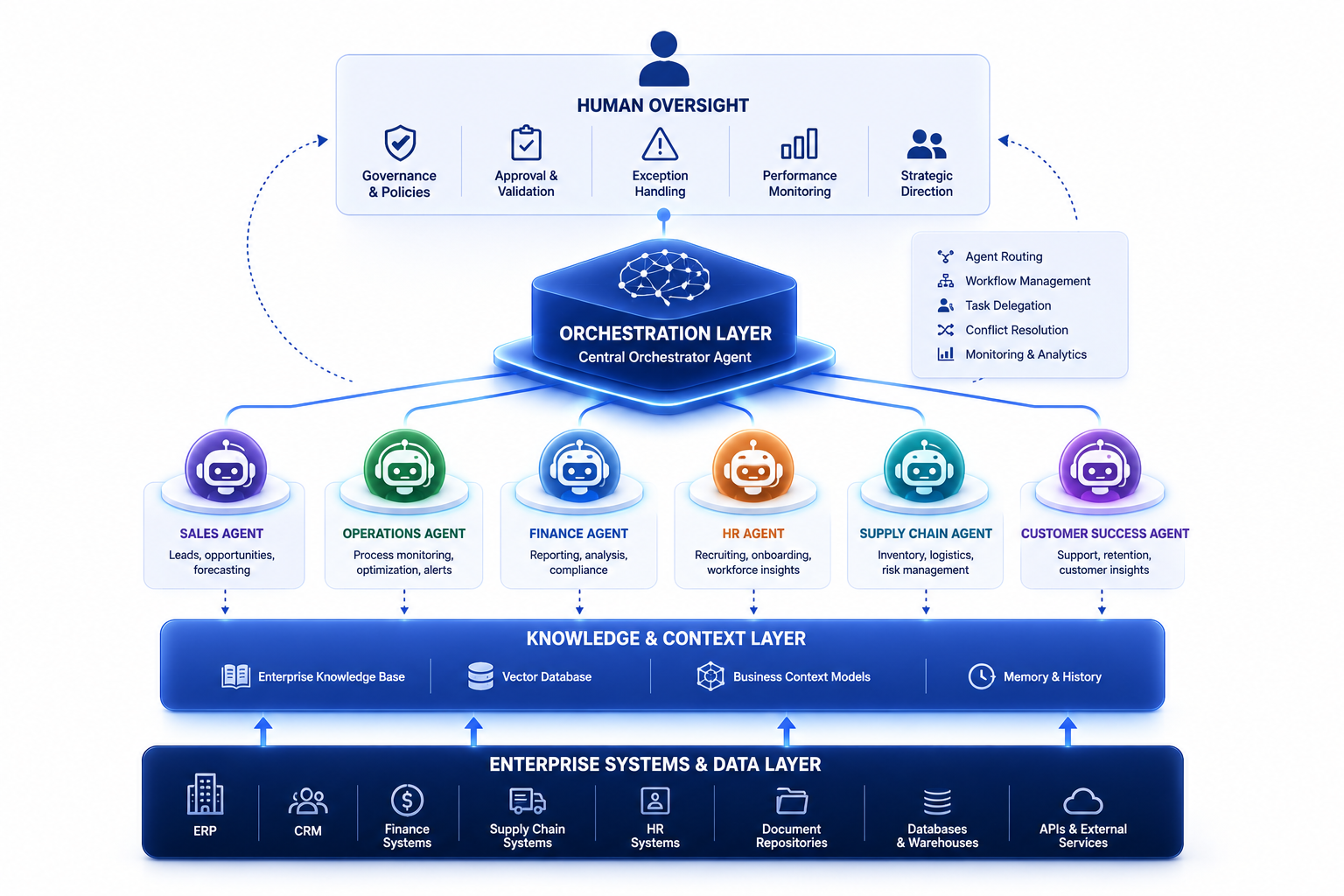
Each layer plays a distinct role in enabling intelligent enterprise operations.
Layer 1: Enterprise Systems & Data
Every agent ecosystem begins with enterprise information.
Agents require access to:
- ERP platforms
- CRM systems
- Supply chain systems
- Financial platforms
- Knowledge repositories
- Customer interactions
- Operational data
Without access to enterprise systems, agents cannot create meaningful business value.
The objective of this layer is to establish trusted access to enterprise information while maintaining security and governance.
Layer 2: Knowledge & Context Layer
Information alone is not enough.
Agents require context.
The knowledge layer transforms enterprise information into actionable intelligence.
Typical components include:
Enterprise Knowledge Bases - Policies, SOPs, documentation, and institutional knowledge.
Vector Databases - Semantic retrieval for agent reasoning.
Business Context Models - Understanding organizational structures, workflows, customers, and products.
Memory Systems - Allowing agents to maintain context across interactions.
This layer serves as the intelligence foundation for every agent within the organization.
Layer 3: Domain AI Agents
This is where specialized intelligence emerges.
Instead of building one massive AI system, organizations deploy multiple domain-specific agents.
Examples include:
Sales Agent - Lead qualification, opportunity tracking, and forecasting.
Customer Success Agent - Support, retention, and engagement management.
Operations Agent - Monitoring workflows and identifying bottlenecks.
Finance Agent - Reporting, compliance, and analysis.
Supply Chain Agent - Inventory optimization and logistics coordination.
HR Agent - Recruitment support and workforce planning.
Each agent becomes an expert within a specific business function.
Layer 4: Orchestration Layer
As the number of agents increases, coordination becomes essential.
This layer acts as the enterprise conductor.
Responsibilities include:
Agent Routing - Determining which agent should handle a task.
Workflow Management - Coordinating multi-step business processes.
Task Delegation - Distributing work across agents.
Conflict Resolution - Managing overlapping responsibilities.
Monitoring - Tracking agent performance and outcomes.
Without orchestration, organizations risk creating disconnected islands of intelligence.
With orchestration, agents become part of a unified enterprise operating system.
Layer 5: Human Oversight Layer
Contrary to popular belief, successful agentic systems do not remove humans from the process.
They elevate human decision-making.
This layer provides:
Approval Workflows - Critical decisions remain under human control.
Governance Controls - Ensuring compliance and accountability.
Exception Handling - Escalating unusual situations.
Ethical Oversight - Managing risk and responsible AI practices.
Strategic Direction - Humans continue defining objectives and priorities.
The goal is not autonomous enterprises.
The goal is augmented enterprises.
Types of Agentic Architectures
Organizations generally evolve through three architectural patterns.
Level 1: Single Agent
One agent performs a specific task.
Example: Customer support assistant.
Suitable for:
- Early experimentation
- Limited use cases
- Departmental pilots
Level 2: Multi-Agent Systems
Multiple agents collaborate across functions.
Example: Sales Agent + Finance Agent + Operations Agent.
Suitable for:
- Cross-functional workflows
- Enterprise automation
- Shared business processes
Level 3: Enterprise Agent Networks
An orchestrated ecosystem of specialized agents operating across the organization.
Example:
An enterprise where agents support every major business function while coordinating through a central intelligence layer.
Suitable for:
- AI-native organizations
- Enterprise-scale transformation
- Continuous optimization
Example: Enterprise Procurement Workflow
Consider a procurement request.
Traditional process:
Employee → Manager → Procurement → Finance → Vendor
Agentic process
Employee → Procurement Agent → Finance Agent → Vendor Intelligence Agent → Manager Approval → Purchase Execution
Workflows become faster, more intelligent, and significantly more scalable.
Governance Principles for Agentic Systems
Every enterprise should establish clear governance standards.
Transparency - Understand how decisions are made.
Security - Protect sensitive information.
Auditability - Track actions performed by agents.
Accountability - Define ownership and responsibility.
Human Control - Ensure appropriate oversight for critical decisions.
Governance is not optional. It is foundational.
Common Implementation Mistakes
Building One Agent for Everything
Specialized agents generally outperform general-purpose enterprise agents.
Ignoring Knowledge Management
Agents cannot reason effectively without high-quality context.
Lack of Orchestration
Multiple agents without coordination create operational complexity.
Over-Automation
Not every decision should be delegated.
Missing Governance
Scaling agents without controls introduces significant risk.
Future State: The Agentic Enterprise
Over the next decade, organizations will increasingly operate through networks of human and AI collaborators.
Employees will focus on:
- Strategy
- Creativity
- Leadership
- Relationship management
- Complex problem solving
Agents will handle:
- Information retrieval
- Analysis
- Coordination
- Routine decisions
- Workflow execution
The result is an enterprise that operates with greater speed, intelligence, and adaptability.
Final Thoughts
Agentic Architecture represents the next evolution of enterprise technology.
Organizations that successfully deploy intelligent agent ecosystems will unlock new levels of productivity, responsiveness, and innovation.
The Enterprise Agentic Architecture Framework provides a structured approach for designing these systems responsibly and at scale.
Rather than replacing humans, agentic architectures create organizations where human expertise and artificial intelligence work together to achieve outcomes that neither could accomplish alone.
The future of enterprise AI is not a single model or chatbot. It is an orchestrated ecosystem of specialized agents, connected to enterprise knowledge and governed through human oversight.