
The AI-Native Enterprise Framework
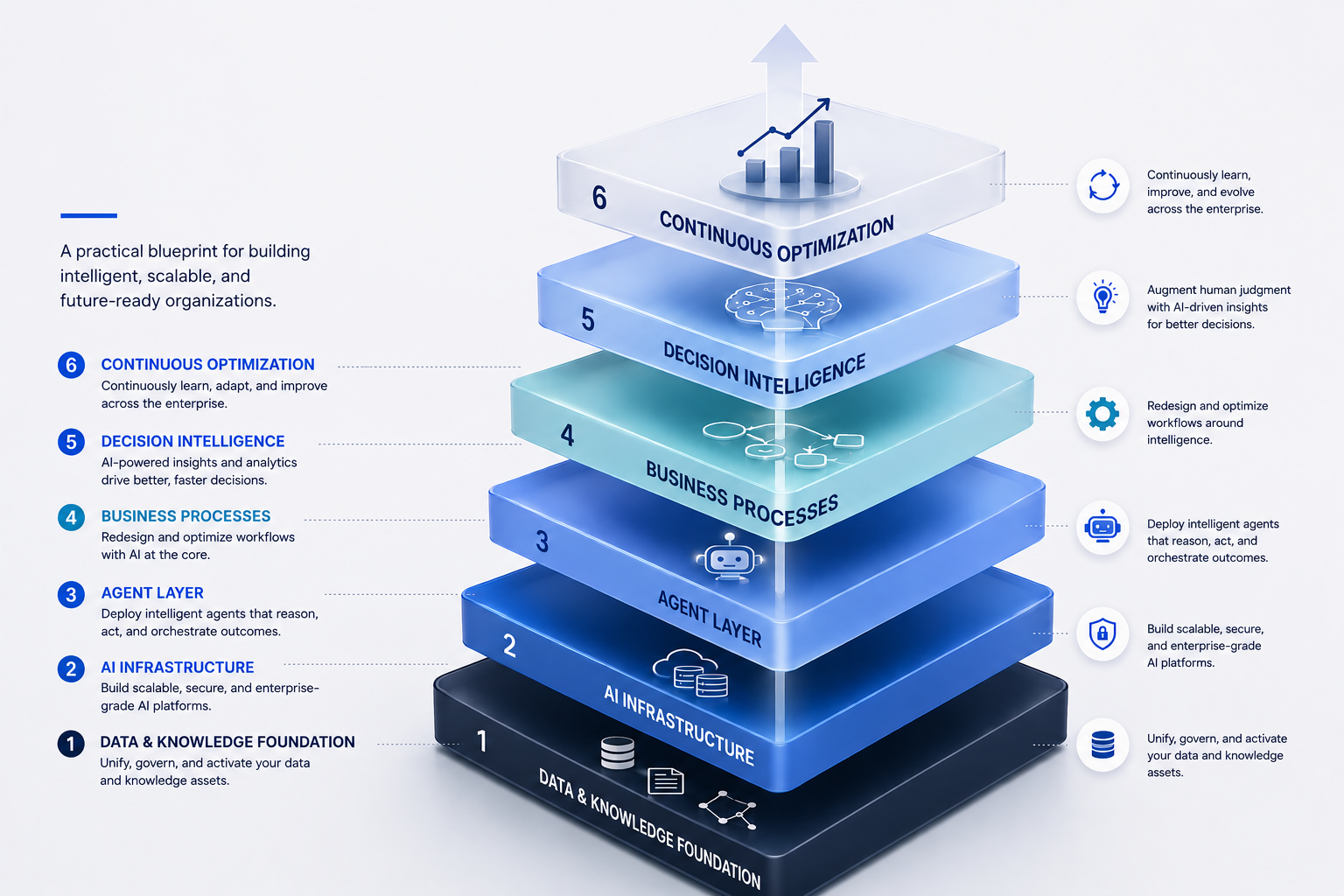
A Practical Blueprint for Building Organizations That Scale with AI
Artificial Intelligence is no longer a technology initiative. It is becoming the foundation upon which modern enterprises operate, compete, and grow.
Many organizations have already deployed AI pilots, experimented with generative AI tools, and launched automation initiatives. Yet despite significant investments, few have successfully transformed into truly AI-native organizations.
The reason is simple.
Most enterprises treat AI as a collection of isolated projects rather than a core operating capability.
An AI-native enterprise is different. It embeds intelligence into every layer of the organization—from data and infrastructure to workflows, decision-making, and customer experiences.
This framework provides a practical blueprint for organizations seeking to move beyond experimentation and build sustainable competitive advantage through AI.
What Is an AI-Native Enterprise?
An AI-native enterprise is an organization where intelligence is embedded into business operations, enabling humans and AI systems to work together to improve productivity, decision-making, innovation, and customer outcomes.
Rather than asking:
"Where can we use AI?"
AI-native organizations ask:
"How should our business operate when intelligence is available everywhere?"
This shift fundamentally changes how organizations think about technology, processes, teams, and growth.
The AI-Native Enterprise Framework
The framework consists of six interconnected layers.
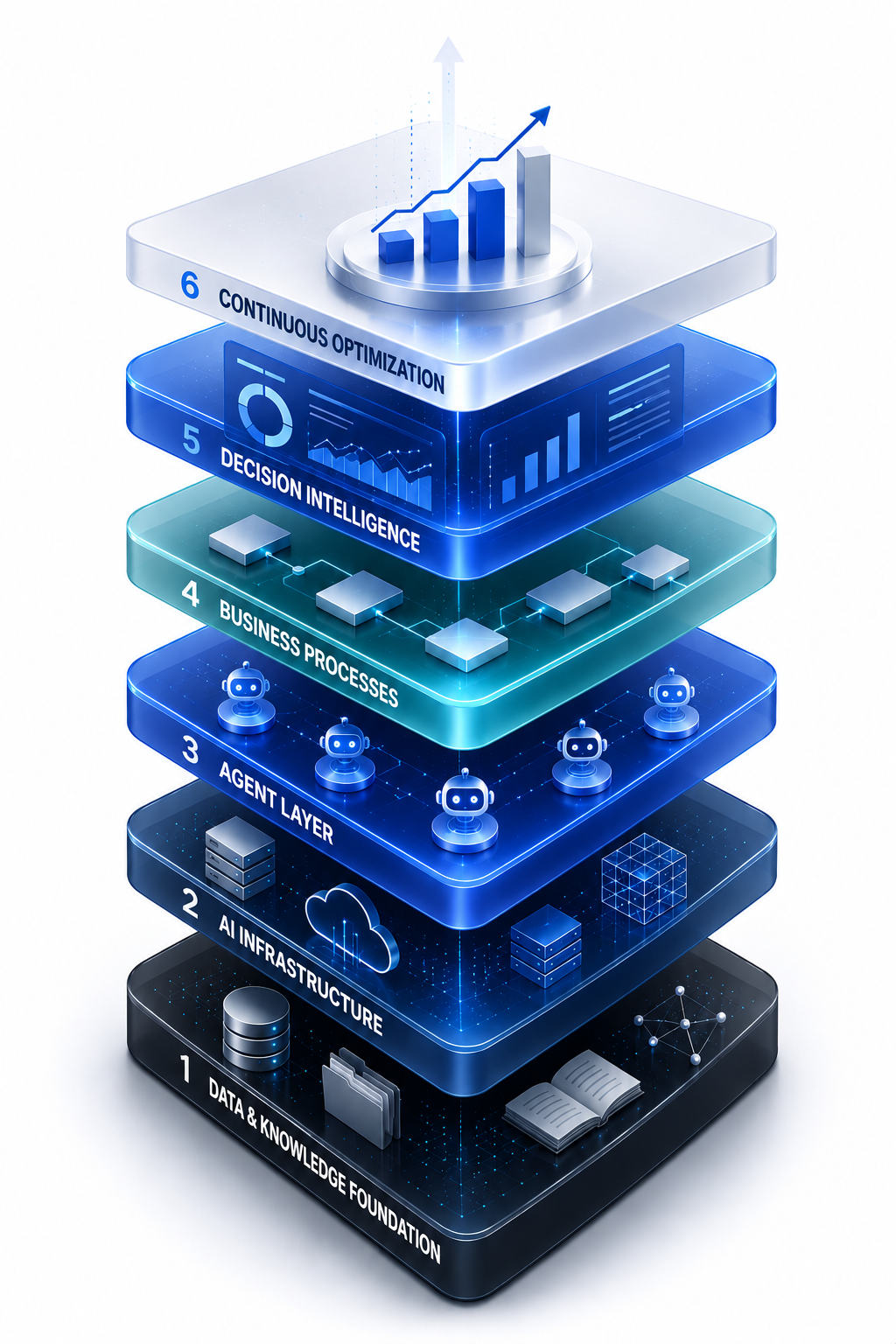
Each layer builds upon the one below it.
Without a strong foundation, enterprise AI initiatives struggle to scale.
Layer 1: Data & Knowledge Foundation
Everything begins with data.
Organizations often possess valuable information across multiple systems:
- ERP platforms
- CRM systems
- Operational databases
- Documents
- Emails
- Knowledge repositories
- Process documentation
- Customer interactions
Unfortunately, this information is usually fragmented.
The goal of the data and knowledge layer is to create a unified enterprise intelligence foundation.
Key capabilities include:
Data Integration
Connecting structured and unstructured information across the enterprise.
Knowledge Management
Transforming documents, policies, SOPs, and institutional knowledge into AI-accessible assets.
Data Governance
Ensuring quality, ownership, security, and compliance.
Semantic Understanding
Creating context that allows AI systems to understand relationships between information.
Organizations that skip this layer often discover that AI simply amplifies existing data problems.
Layer 2: AI Infrastructure
Once the data foundation is established, organizations require infrastructure capable of supporting intelligent applications.
This layer provides the technological backbone for enterprise AI.
Core components include:
Model Platforms
Large Language Models (LLMs), specialized AI models, and domain-specific intelligence systems.
Vector Databases
Supporting retrieval-augmented generation and enterprise search.
AI Development Platforms
Tools for building, testing, deploying, and monitoring AI solutions.
Security & Compliance Controls
Ensuring enterprise-grade governance and risk management.
Integration Frameworks
Connecting AI capabilities with existing enterprise systems.
The objective is not merely deploying models but establishing a scalable AI platform that supports future growth.
Layer 3: The Agent Layer
This is where organizations begin moving from automation to intelligence.
Traditional software follows predefined rules.
AI agents can reason, plan, retrieve information, and execute actions toward business objectives.
Examples include:
Customer Support Agents
Handling inquiries and escalating complex situations.
Operations Agents
Monitoring workflows and coordinating processes.
Knowledge Agents
Searching organizational information and answering employee questions.
Analytics Agents
Generating insights and recommendations from enterprise data.
Industry-Specific Agents
Supporting manufacturing, healthcare, finance, logistics, or sustainability operations.
Organizations increasingly deploy multiple specialized agents coordinated through orchestration frameworks.
This creates a scalable intelligence network across the enterprise.
Layer 4: Business Process Transformation
Many organizations focus on implementing AI tools.
AI-native organizations redesign workflows around intelligence.
This distinction is critical.
Instead of:
Existing Process + AI Tool
Organizations should pursue:
AI-Optimized Process
Examples include:
Sales
AI-assisted prospecting, qualification, forecasting, and customer engagement.
Operations
Predictive planning, exception management, and intelligent workflow routing.
Supply Chain
Demand forecasting, inventory optimization, and logistics coordination.
Customer Experience
Personalized journeys, support automation, and proactive engagement.
Knowledge Work
Research, documentation, reporting, and content generation.
The greatest value often emerges not from AI itself but from reimagining how work gets done.
Layer 5: Decision Intelligence
As organizations mature, AI begins supporting decision-making rather than simply executing tasks.
Decision Intelligence combines:
- Data
- Analytics
- Business rules
- Predictive models
- Human expertise
to improve outcomes.
Examples include:
Executive Decision Support
Strategic planning informed by real-time intelligence.
Risk Management
Early identification of operational and financial risks.
Resource Allocation
Optimizing investments and workforce deployment.
Revenue Growth
Identifying opportunities and predicting customer behavior.
The objective is not replacing human judgment.
It is augmenting leadership with better information, greater visibility, and faster insights.
Layer 6: Continuous Optimization
The most advanced organizations treat AI transformation as a continuous capability rather than a one-time initiative.
This layer creates feedback loops that allow the enterprise to improve continuously.
Key components include:
Performance Monitoring
Tracking business and AI outcomes.
Process Optimization
Identifying bottlenecks and inefficiencies.
Model Improvement
Enhancing accuracy and relevance over time.
Agent Evolution
Expanding capabilities as business needs change.
Organizational Learning
Capturing lessons and institutional knowledge.
The result is an enterprise that becomes smarter with every interaction.
The Human Layer: The Invisible Seventh Layer
While technology receives most of the attention, successful AI-native organizations recognize that transformation is fundamentally about people.
Every layer of the framework requires:
- Leadership alignment
- Change management
- Workforce enablement
- Skills development
- Governance
- Trust
Organizations that focus solely on technology often struggle with adoption.
Organizations that combine technology with cultural transformation create sustainable competitive advantage.
Common Mistakes Organizations Make
Mistake 1: Starting with Tools
Buying AI software before defining business outcomes.
Mistake 2: Ignoring Data Readiness
Expecting AI to solve poor-quality data challenges.
Mistake 3: Running Isolated Pilots
Creating disconnected experiments that never scale.
Mistake 4: Treating AI as an IT Initiative
Limiting ownership to technology teams.
Mistake 5: Underestimating Change Management
Assuming employees will naturally adopt new ways of working.
A Maturity Roadmap for Adoption
Organizations typically evolve through five stages.
Stage 1: Exploration
Testing AI use cases and building awareness.
Stage 2: Experimentation
Running pilots within individual functions.
Stage 3: Operationalization
Deploying successful AI solutions into production.
Stage 4: Enterprise Scale
Creating shared platforms and governance.
Stage 5: AI-Native Enterprise
Embedding intelligence across all business functions.
Each stage builds the foundation for the next.
Attempting to skip stages often leads to stalled initiatives and disappointing results.
Final Thoughts
AI is rapidly becoming a foundational capability for modern enterprises.
Organizations that view AI as a collection of isolated tools will likely achieve incremental gains.
Organizations that build an AI-native operating model will redefine productivity, innovation, and competitive advantage.
The AI-Native Enterprise Framework provides a structured path toward that future.
It begins with data and knowledge, scales through infrastructure and intelligent agents, transforms business processes, enhances decision-making, and ultimately creates a continuously learning organization.
The question is no longer whether AI will transform your industry.
The question is whether your organization is building the capabilities required to lead that transformation.
Key Takeaway
AI-native enterprises are not built by deploying AI tools. They are built by embedding intelligence into the foundation of how the organization operates, decides, learns, and grows.